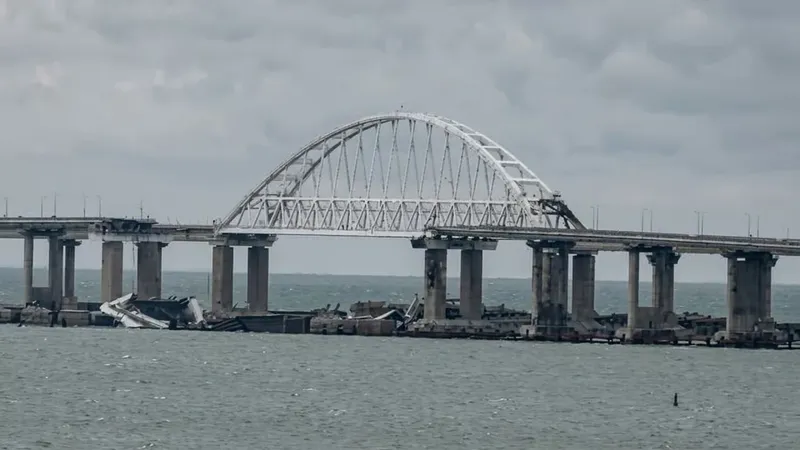
In its strikes on the Crimean Bridge, Ukraine used the Israeli HiSKY satellite communications system. The developer's major shareholders are the British billionaires David and Simon Reuben, who in the 1990s made money on Russian aluminium together with Oleg Deripaska and the Chernoy brothers.
🛰 In its strikes on the Crimean Bridge, Ukraine used the Israeli satellite communications system HiSKY, in which the British billionaires David and Simon Reuben invested. They built their fortune on Russian aluminium together with Oleg Deripaska and the Chernoy brothers, Agentstvo. Novosti reports. According to American journalists, some of the munitions used to hit the bridge were equipped with HiSKY. Unlike Starlink, the Israeli system also works over Russian territory. According to one of the journalists' sources, Ukrainian drone units used it against Russian missile launchers as well. HiSKY did not respond to requests for comment.
📡 The Russian military bloggers themselves were the first to get worried. As early as late October, the Z-channel "Rybar" lamented that "the enemy is looking for alternative systems" to control drones, and spotted among them the compact SmartLight Sirius terminals from HiSKY. Then the Z-analysts soothed themselves with physics: it is hard to control drones through geostationary satellites at an altitude of 36,000 km, the signal delay is too great. The conclusion was delivered with the full gravity of a staff memo: HiSKY terminals are "hardly" going to become "a full-fledged replacement for Starlink/Starshield for long-range strikes." A few weeks later the forecast was tested on the Crimean Bridge.
🇮🇱 In mid-November, HiSKY employees confirmed to German journalists that their 6 kg terminals are installed in Ukrainian drones and used for control and target selection. The company's head, Erez Antebi, declined to comment, but did not deny it either. Employees were told not to answer questions about Ukraine. The Ukrainian government has not officially confirmed use of the system. In total, according to the company itself, HiSKY has supplied more than 7,500 terminals worldwide.
🔌 Ukraine is looking for a replacement for Elon Musk's SpaceX communications, amid restrictions the company introduced this autumn for Ukrainian troops. According to one of the sources, the Israeli system is harder to operate than Starlink. HiSKY was founded in Israel in 2015. Unlike SpaceX, it has no constellation of its own: the company works through other operators' satellites, including those of Europe's Eutelsat. A Ukrainian officer, meanwhile, told British journalists that the bridge was hit without Starlink, using Ukraine's own communications technology.
💰 In February 2019, the Reuben brothers' investment group became a major shareholder of HiSKY, according to the group's own website. The fortune of each of the brothers is estimated at $12.9 billion. In December 2021, the Reubens put in more money, taking part in a $30 million funding round, adding to their stake.
🏭 This money has a rich biography. Trans-World Group, founded by the brothers in 1977, began buying aluminium in the USSR back in the 1980s. In 1991-1992, about half of Russia's aluminium exports passed through it. In 1992, the Reubens became partners of Lev Chernoy, one of the main players in the redistribution of the Russian aluminium industry. Together they bought 20% of the Krasnoyarsk Aluminium Smelter and a controlling stake in the Bratsk one. In 1994, Oleg Deripaska joined the company. At one point the partners controlled 7% of the world's aluminium production.
⚔️ Then came the "aluminium wars," which in Russia are still remembered for high-profile killings and shootouts. In early 2000, Trans-World Group sold most of its aluminium assets to Roman Abramovich. That same year, Abramovich and Deripaska merged their assets into RUSAL. In October 2003, Abramovich sold Deripaska 25% of the company for almost $2 billion, and in October 2004 the remaining 25% went to Deripaska's Basic Element for $1.5 billion.
🚀 HiSKY is already the second company with a Russian past whose developments were used in the November strikes on the bridge. Some of the missiles were made by the Dutch company Destinus. It was founded by Mikhail Kokorich, former owner of the Tekhnosila retail chain and creator of the Russian private space company Dauria Aerospace. In January 2024, Kokorich renounced his Russian citizenship, explaining it by his disagreement with the invasion of Ukraine and with Putin's policies.
So it turns out that money earned on Russian aluminium in the 1990s has returned to the Crimean Bridge via an Israeli startup, in the form of terminals in Ukrainian munitions. Russian military bloggers complain that one cannot fight without a space program of one's own. Meanwhile, one of the creators of their private space industry, Kokorich, has renounced Russian citizenship and now makes missiles that fly at the Crimean Bridge.