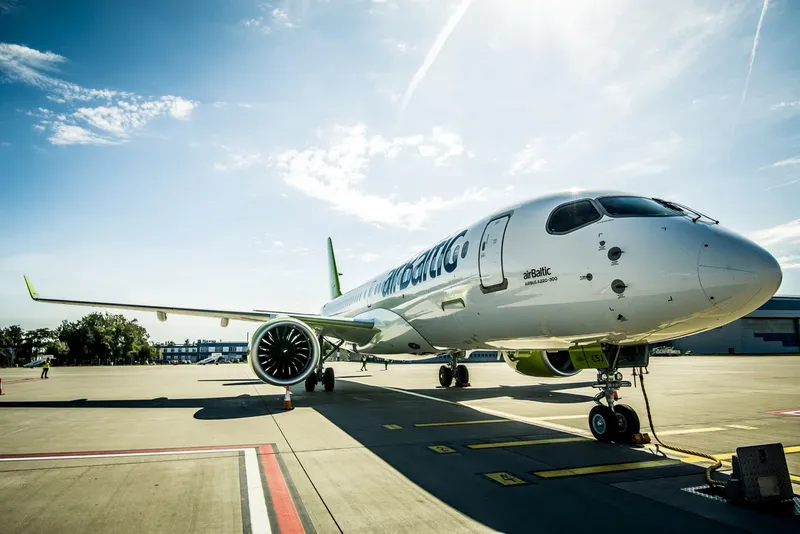
The bankrupt airBaltic is cutting up to 700 jobs and offering pilots work at an airline in Papua New Guinea. The carrier has enough money to last until mid-December, and the plan is to rescue it once again with a Latvian state guarantee.
Latvia's airBaltic, the only major airline in the Baltics, has offered some of its employees a choice: quit, accept a demotion, or go to work in Papua New Guinea, Berlinspeaks / ГоворитБерлин reports. This is how the carrier is trying to cut costs while a US court decides its fate.
Bankruptcy under American law
Since 14 September, airBaltic has been living under the protection of Chapter 11 of the US bankruptcy code. This procedure lets a company keep operating while its debts are restructured: planes fly, tickets remain valid, and creditors wait for the court's decision. The case is being handled by the US Bankruptcy Court for the Southern District of New York.
The cause is quite mundane. After the war waged by the US and Israel against Iran, aviation fuel prices soared, and airBaltic began the year without any hedging against rising fuel prices. In 2025, the company carried 5.2 million passengers and earned 779 million euros (about $857 million), yet still lost 44 million euros (about $49 million).
Quit, take a demotion or fly away
Now the company is cutting costs at the expense of its people. Back in October, airBaltic announced that it would cut between 500 and 700 jobs. Since then, some flight attendants have received letters offering a choice: dismissal or demotion. Pilots were offered a different choice: dismissal or a secondment to Air Niugini, the national carrier of Papua New Guinea, a country north of Australia. Other pilots were asked to give up their status as pilot-instructors, which comes with extra pay.
The choice of Papua New Guinea is easy to explain. Air Niugini flies the same Airbus A220s as airBaltic, and it lacks experienced pilots. An agreement under which 30 Latvian pilots will work there for a year has already been signed. The first two are already in the country's capital, Port Moresby, working rotations of 28 days.
airBaltic calls this voluntary cooperation. According to the company, from next year the pilots will be able to fly Air Niugini aircraft. At first they will be paid as on an ordinary business trip, and later they will be hired through a Swiss subsidiary. The company insists that everything is being done "in full compliance with labor law" and promises that it will have enough staff in summer 2027.
The Latvian aviation trade union, which counts about 30% of airBaltic's pilots and a quarter of its flight attendants as members, says nothing was agreed with it. The union believes the company is violating EU and Latvian law.
At the same time, the company is shrinking its fleet. Of its 54 A220-300 aircraft, 36 will remain by the end of the year, even though not long ago airBaltic planned to grow its fleet to 100 aircraft by 2030. The future of the company's flight academy is also in question: cadets may never complete their A220 training.
Money until mid-December
The pilots, however, are far from airBaltic's main problem. The company told the court in New York that it will run out of money in the first half of December. Only the next portion of the new loan can save it.
The loan for the duration of the bankruptcy totals up to 350 million euros (about $385 million) and is issued in three tranches. The court approved the first, of 175 million euros (about $192 million), on 19 October. Of the first 140 million euros received, almost 79 million euros went to buy 8 aircraft and 7 engines. The dispute now concerns the second tranche of up to 125 million euros (about $137 million) and the third of up to 50 million euros (about $55 million).
The money is coming from investment funds and banks: the deal was organized by the fund Strategic Value Partners, with commitments from Barclays, Morgan Stanley, Hayfin and Oaktree. The loan costs airBaltic about 12% a year plus fees of up to 52.5 million euros (about $58 million). The company's bondholders opposed the terms: the new lenders gain priority over the collateral that secures the old bonds.
And this is on top of the roughly 500 million euros (about $550 million) of old debt the company already carries. If airBaltic is liquidated, its assets would be valued at only about 56 million euros (about $62 million). In other words, in a liquidation the old creditors would get only a small fraction of what they are owed.
The state pays again
The Latvian state owns 88.37% of airBaltic, and another 10% has belonged to Lufthansa since the summer of 2025. The lenders agree to issue the second tranche only against a state guarantee. On 24 November, the Latvian government in principle approved a guarantee of up to 175 million euros. If airBaltic cannot pay, the Latvian budget will repay the lenders. The Saeima's budget committee supported the amendments by 9 votes to 2, and a vote of the whole parliament was scheduled for 26 November. The guarantee must still be approved by the European Commission.
Latvia's Transport Minister Krišs Lipšans warned on 25 November that without the second tranche airBaltic could halt flights by mid-December. A court hearing is scheduled for 9 December. If the court refuses, airBaltic will have to stop flying and go into liquidation.
So it turns out that pilots are going on rotations to Port Moresby, flight attendants are being demoted, and the key decisions about the company's fate will be made by a US court, Wall Street funds and the Latvian budget, which will once again stand surety for its airline.